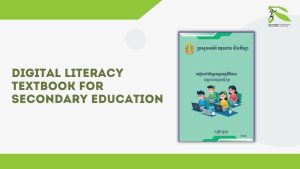
Education is a key sector contributing to the development of human resources aimed at promoting economic and social development. The Royal Government of Cambodia continues to prioritize the education sector to ensure the full development of human capital, in response to technological advancement and digital transformation, which have been and continue to provide new opportunities for learning, employment, and new forms of business, actively contributing to accelerating economic and digital social development in Cambodia. The Ministry of Education, Youth and Sport has improved the curriculum and implemented extracurricular programs to strengthen students’ skills and knowledge by linking theory with practice across all subjects, especially in STEM and digital education, with the aim of enhancing the quality of human resources in terms of knowledge, skills, ethics, and physical well-being, in order to meet personal needs and the demands of the national and international labor markets. The Ministry of Education, Youth and Sport has also collaborated with ChildFund Cambodia to develop an extracurricular digital literacy program for primary and secondary education, with the objective of providing students with fundamental knowledge of digital technology use to support learning, 21st-century skills, and lifelong learning skills, enabling students to better prepare and develop themselves in the digital era.
The digital literacy textbooks have been developed as teacher guides and student books across four levels, aligned with students’ abilities: 1. Basic level for primary education, 2. Basic level for secondary education, 3. Intermediate level for secondary education, and 4. Advanced level for secondary education. Each level consists of three chapters: 1. Foundations of digital literacy, 2. Digital content creation, and 3. Problem-solving and coding. Each chapter requires approximately 8 to 12 hours for learning and practice. The information technology programs used in this curriculum are mostly open-source and openly licensed software that can be used free of charge, in accordance with the terms and conditions set by the owners. Teachers may incorporate other software that supports the objectives of the curriculum, depending on technological developments, available resources, and their own capacities.
The intermediate-level digital literacy textbook for secondary education is designed to provide students with additional knowledge in using digital technology to support learning and work, creating digital content with high utility and value, solving problems, and generating innovative ideas to meet the needs of communities and society.
The student book is designed in a structured format, highlighting lesson objectives, detailed content, and exercises. The teacher guide is developed with objectives, teaching methodologies (IBL/PBL), teaching hours, instructional materials, teaching models, and homework assignments to assist teachers in lesson planning and delivery. The teaching models and methods presented in the teacher guide are one approach that teachers can use; however, in actual teaching practice, teachers should adapt flexibly according to students’ abilities and available resources.